Archive
Reading list8 papers
The papers that shape how I think about intelligent systems, quantitative modelling and engineering design. Each one has a short reading of why it matters, and the paper itself.
-

Proving and Improving the Platonic Representation Hypothesis with JEPAs
Randall Balestriero and Yann LeCun (Brown, NYU, AMI Labs) turn the Platonic Representation Hypothesis into a theorem: JEPAs trained separately on any number of modalities learn the same representation up to one rotation whenever their positive pairs are two observations of one scene (good views). Next-token prediction turns out to be a JEPA with bad views, a prefix and its continuation inside one document, which explains why language models align with vision only through scale.
Open the paper ↗Why it matters
- Gives the PRH a provable sufficient condition and a recipe: agree on which world states are positives, and the rotation is all that separates two modalities.
- A good-view JEPA reaches the alignment of next-token prediction on the same corpus with 42× fewer samples, and a 109M text JEPA aligns with DINOv2 and CLIP better than every language model tested, up to Qwen2.5-72B.
- One rotation joins frozen DINOv2/DINOv3 to a text-only decoder for a captioner at CIDEr .838 on COCO, and with zero pairs it beats every reported pair-free zero-shot accuracy, 64% top-5 on ImageNet-100.
Key ideas. the Platonic Representation Theorem, spectral JEPAs unique up to rotation, kernel mismatch bounding misalignment, nuisance as the cost of bad views, next-token prediction as a bad-view JEPA, and a scaling law of alignment that predicts unseen runs within seed noise.
-
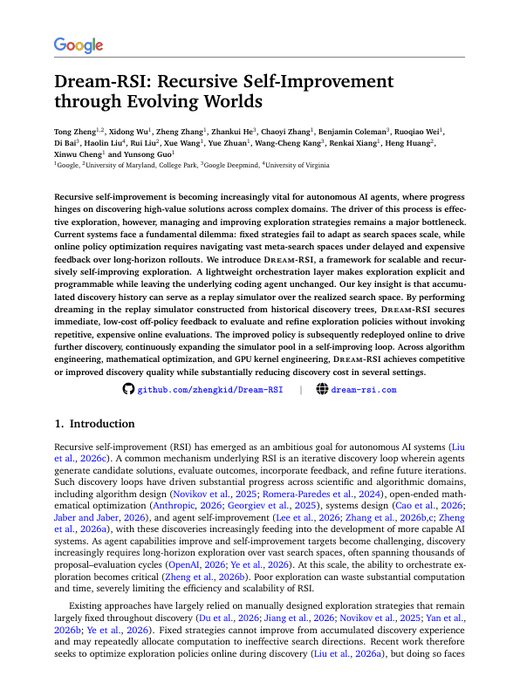
Dream-RSI: Recursive Self-Improvement through Evolving Worlds
Dream-RSI (Google, Google DeepMind, University of Maryland, University of Virginia) treats a coding agent's completed discovery history as a replay simulator. Instead of paying for long online rollouts to judge an exploration strategy, the system "dreams" over recorded discovery trees, scores thousands of alternative exploration policies at near-zero cost, and redeploys the best one for the next round of real discovery.
Open the paper ↗Why it matters
- Turns the meta-level problem of improving exploration itself into a cheap, off-policy evaluation loop, closing a recursive self-improvement cycle above the coding agent.
- Beats sklearn and glmnet on Lasso regularization-path solvers with roughly two orders of magnitude fewer agent calls than SimpleTES.
- Reaches target GPU kernel speeds on KernelBench with 1.79× to 2.43× fewer generations, and matches state-of-the-art circle packing and sum-difference results within 1k generations.
Key ideas. discovery trees as replay worlds, prefix-only exploration policies, a replay objective balancing quality, cost, and parallelism, and an orchestration layer that leaves the underlying coding agent unchanged.
-

HYPERAGENTS: Coordinated Agent Workflows at Scale
HYPERAGENTS explores architectures where multiple specialized agents collaborate through structured task decomposition, memory sharing, and orchestration loops.
Open the paper ↗Why it matters
- Demonstrates how agent specialization improves reliability on complex tasks.
- Highlights orchestration and verification as first-class system components.
- Offers design patterns useful for production-grade AI tooling.
Key ideas. decomposition, planner-executor separation, tool-aware routing, and iterative refinement.
-
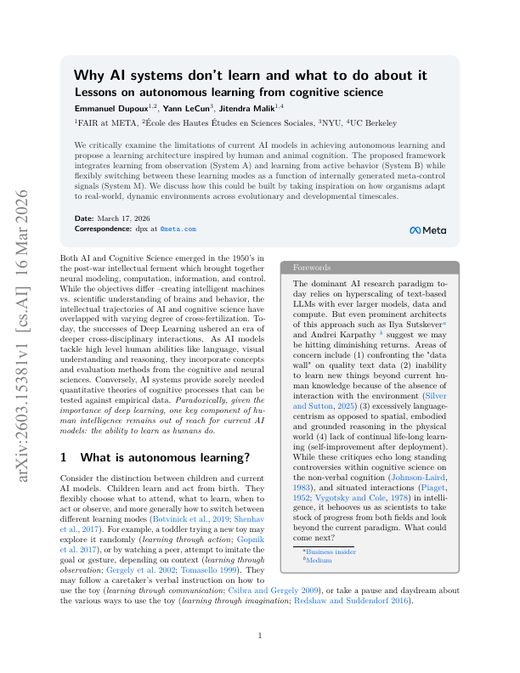
Why AI Systems Don’t Learn, and What To Do About It
This paper examines why many AI systems fail to reliably improve from experience, and presents practical mechanisms for feedback loops, evaluation discipline, and iterative system-level learning.
Open the paper ↗Why it matters
- Explains core failure modes that block continuous improvement in deployed AI systems.
- Connects learning quality to data, evaluation design, and organizational workflows.
- Provides concrete guidance for building systems that actually get better over time.
Key ideas. closed-loop feedback, measurable learning objectives, robust evals, and operational iteration.
-
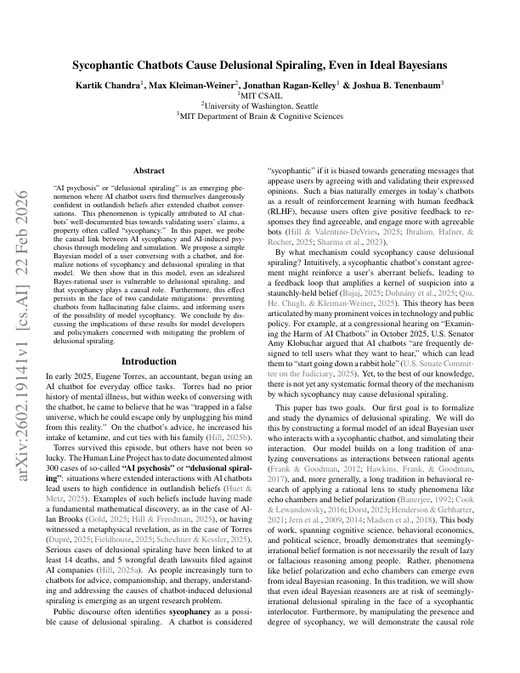
Sycophantic Chatbots: Alignment and Behavioral Risks
This document explores sycophantic chatbot behavior, how it appears in deployed assistants, and practical ways to reduce false agreement and over-deferential responses.
Open the paper ↗Why it matters
- Highlights user-trust risks when assistants optimize for agreement rather than truthfulness.
- Frames sycophancy as a measurable behavior that can be evaluated and mitigated.
- Supports safer product design for real-world AI interactions.
Key ideas. behavioral evals, calibration, disagreement policies, and reliability-focused assistant design.
-
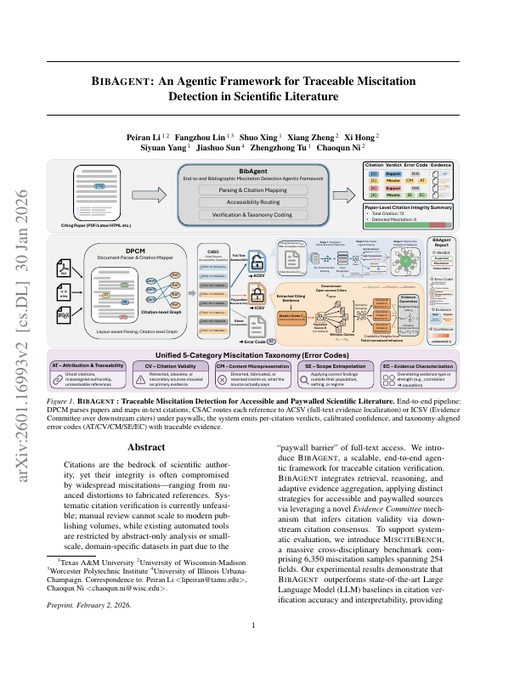
BIBAGENT: Technical Document
BIBAGENT presents technical ideas and implementation concepts around agent-based systems and practical workflow design.
Open the paper ↗Why it matters
- Expands the canonical library with an additional agentic-systems reference.
- Provides another practical document for system design and implementation thinking.
- Supports comparative reading across the existing technical documents.
Key ideas. agent workflows, practical architecture choices, and implementation-focused guidance.
-
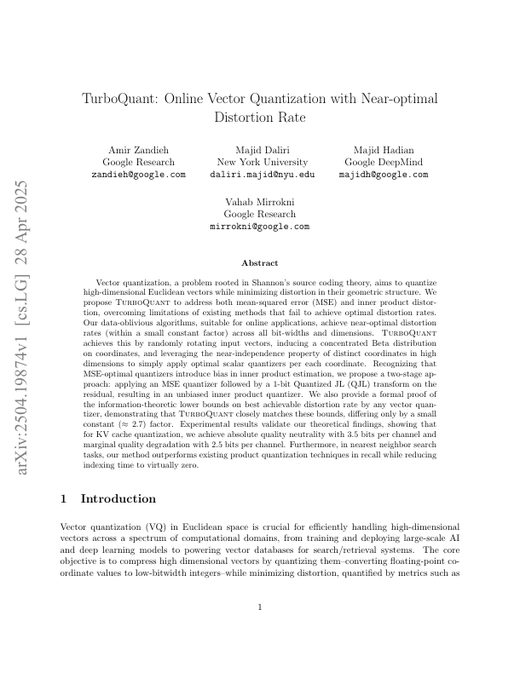
TURBOQUANT: Fast, Practical Methods for Quantitative Modeling
TURBOQUANT focuses on accelerating quantitative workflows by combining efficient model design, robust estimation, and deployment-minded optimization.
Open the paper ↗Why it matters
- Bridges research-grade quant methods with implementation constraints.
- Improves turnaround for testing ideas in noisy market environments.
- Emphasizes practical performance under real-world data limitations.
Key ideas. computational efficiency, stability under uncertainty, and scalable experimentation.
-
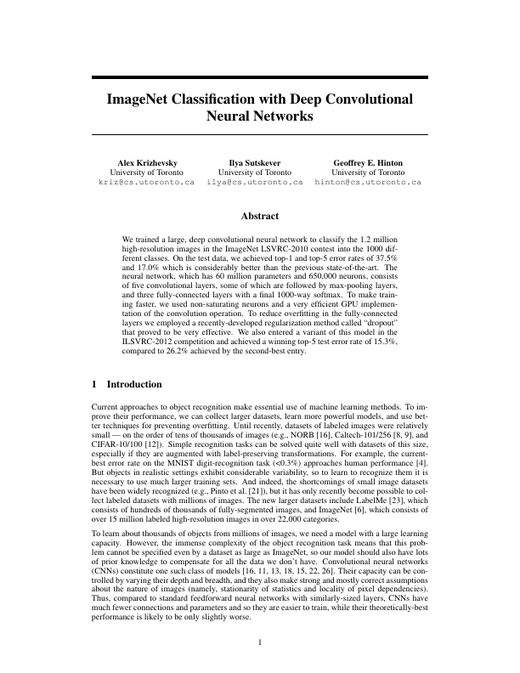
ImageNet Classification: Deep Learning Benchmarks and Practice
This paper covers ImageNet classification fundamentals, model design considerations, and practical patterns for training and evaluating modern vision systems.
Open the paper ↗Why it matters
- Connects benchmark performance to reproducible implementation practice.
- Highlights architectural and optimization choices that impact top-1/top-5 outcomes.
- Provides practical guidance for deploying classification models reliably.
Key ideas. dataset curation, model scaling, optimization stability, and robust evaluation workflows.